Reflections from Chambers
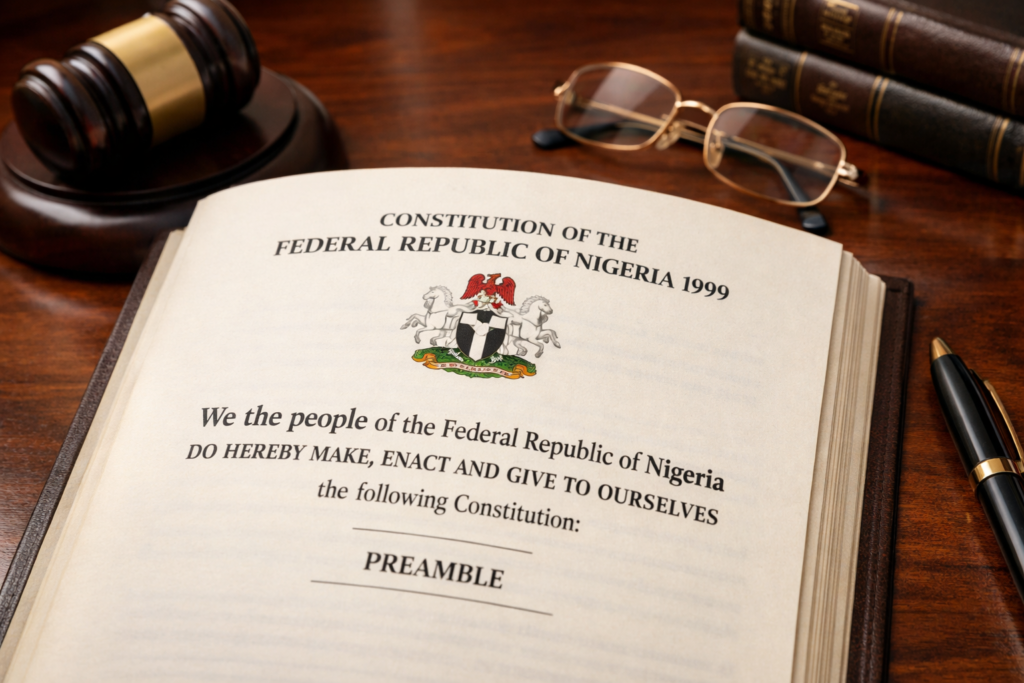
The Constitution of the Federal Republic of Nigeria begins with a striking declaration:
“We the people of the Federal Republic of Nigeria… do hereby make, enact, and give to ourselves the following Constitution.”
These opening words carry significant symbolic weight. They place the Nigerian Constitution within a long tradition of constitutional thought in which the authority of political order is said to originate not from monarchs, military rulers, or colonial administrators, but from the collective will of the people themselves.
Yet the statement also introduces what might be called a constitutional fiction.
In constitutional theory, such language is not unusual. Constitutions often speak in the voice of a unified people acting together to establish the rules of their common political life. The phrase “We the people” represents the principle of popular sovereignty—the idea that legitimate authority ultimately flows from the citizens who compose the political community.
The difficulty in Nigeria’s case is historical. The Nigerian people did not visibly assemble in a constitutional moment to draft, deliberate upon, and adopt the document that now governs them.
The present Constitution entered public life in 1999 through a decree issued during the transition from military rule under Abdulsalami Abubakar. While the transition marked an important return to civilian government, the constitutional text itself did not emerge from a broad civic convention in which citizens collectively articulated the framework of their political union.
This historical circumstance does not negate the Constitution’s legal authority. Nigerian institutions operate under it, courts interpret its provisions, and the state derives its formal structure from its clauses. In legal terms, the Constitution remains the supreme law of the land.
Yet the question raised by its opening words persists.
To what extent do Nigerians experience the Constitution as their own creation?
The Distance Between Text and Civic Life
A constitution can exist as a functioning legal instrument while remaining psychologically distant from the citizens whose lives it structures.
In societies where constitutional ownership is deeply rooted, the document becomes more than a legal framework. It enters the civic imagination. Citizens understand its language, invoke its principles, and see it as a structure that both empowers and restrains public authority.
Nigeria’s experience has often been different.
For many citizens, the Constitution is encountered primarily during political crises, election disputes, or judicial pronouncements. Outside these moments, it rarely appears as a living reference point in everyday civic life.
The result is a subtle but important gap. The Constitution governs the political order, yet the sense that it belongs to the people remains incomplete.
This gap becomes visible in moments of national tension. Citizens invoke constitutional rights in the language of protest, public officials appeal to constitutional authority in the exercise of power, and courts interpret constitutional provisions in resolving disputes. Yet the broader civic culture that sustains constitutional life—public familiarity with the document and a shared sense of its ownership—remains uneven.
The Question of Constitutional Ownership
The issue, therefore, is not simply the historical origin of the Constitution. Many constitutional orders evolve from imperfect beginnings. What ultimately sustains a constitution is not merely the circumstances of its birth but the degree to which a people gradually come to recognize themselves within it.
Ownership of a constitution emerges through civic practice.
Citizens begin to see the document as the architecture of their collective life. Its principles inform political expectations. Its language shapes public debate. Over time, the constitution becomes a shared reference point through which a society interprets both authority and responsibility.
Where this process takes root, the constitutional fiction of “We the people” begins to acquire real meaning.
A Reflection from Chambers
The Nigerian Constitution speaks in the voice of a united people.
Whether that voice fully reflects the lived civic consciousness of the nation remains an open question.
For in the end, the strength of a constitution lies not only in the authority of its provisions, but in the degree to which a people come to recognize themselves in its promise.
And it is through that gradual recognition that the words “We the people” move from constitutional fiction toward constitutional reality.