Legal Commentary And Institutional Analysis On The Structure Of Public Life
Constitutional Reflections is a structured examination of Nigeria’s constitutional framework, its philosophical foundations, and its operational realities. This series explores how constitutional design shapes governance, institutional trust, and national development.
From The Notebook
-
Why Nigerian Politicians Capture Existing Parties Instead of Creating New Ones

Nigerian politics often follows a pattern that may appear unusual to outside observers. Rather than creating entirely new political parties, many influential political actors prefer to “capture” existing smaller parties and transform them into new political platforms.
Recent developments around the African Democratic Congress (ADC) have once again brought this strategy into public discussion. But this phenomenon is not accidental; it reflects deeper structural realities and the high “barrier to entry” in Nigeria’s constitutional and electoral system.

1. The Cost of Building a Party from Scratch
Creating a viable political party in Nigeria is not merely a social exercise; it is a massive logistical and legal undertaking.
The regulatory framework of the Independent National Electoral Commission (INEC) requires that any serious national party must maintain substantial organizational capacity across the federation. To operate effectively, a party must typically have:
- Physical Presence: Offices in at least 24 states (two-thirds of the federation).
- Administrative Depth: Organized leadership structures from the National level down to the Wards.
- Compliance: Continuous legal and financial auditing to maintain registration.
Building these structures requires years of preparation and enormous financial investment. For many political actors, acquiring an existing party provides a “Turnkey Solution.” They skip the most difficult stages of institutional formation by inheriting a “shell” that already possesses legal recognition and ballot access.
2. The Historical Precedents: From Merger to Occupation
This strategy has two distinct flavors: the Merger (Institutional) and the Occupation (Personal).
- The Merger (APC, 2013): Several established parties—the ACN, CPC, ANPP, and a faction of APGA—combined their existing legal shells to create a national powerhouse. They didn’t start from zero; they aggregated existing infrastructure.
- The Occupation (Labour Party, 2023): This is perhaps the most famous recent example. An external political movement (the “Obidient” movement) moved into a long-existing but relatively quiet party (Labour Party). By occupying its shell, they gained immediate ballot access and a national platform without waiting for the multi-year INEC registration process.

3. The “Party Shell” Acquisition Model
Many smaller political parties in Nigeria possess valuable institutional assets, even if they lack national visibility. This creates a natural exchange between political elites and party “owners.”
What Political Elites Bring What Smaller Parties Provide Funding & Campaign Resources Legal Party Registration (The Shell) National Visibility & “The Crowd” Ballot Access & Electoral Symbols Political Networks Existing State-level Infrastructure In this model, the institutional shell already exists. New political actors simply occupy and reshape it.
4. The Litigation Risk: Why Leadership Disputes Follow
When powerful political figures enter a smaller party, internal tensions are almost inevitable. These tensions usually arise between the Founders (who built the shell) and the Entrants (who bring the money and influence).
Because control of the party is the ultimate prize, these disputes frequently move from the party secretariat to the courtroom. The leadership dispute involving David Mark and the ADC reflects a pattern where the battle is not just over “policy,” but over the legal right to sign the nomination forms for candidates.
5. The Deeper Structural Issue: Vessel vs. Institution
At a deeper level, this reflects a system where parties often function primarily as electoral vehicles rather than long-term ideological institutions.
In many Western democracies, a politician’s career is defined by their service to a party. In Nigeria, the sequence is often reversed: They first capture the party, and then the party becomes an extension of their political identity. The party becomes a vessel—a container waiting to be filled by the next coalition of power.
Looking Ahead
Understanding this pattern offers a deeper insight into why certain “marginal” parties suddenly become the center of national conversation. They are the empty containers that the next wave of political realignment will inevitably seek to fill.
In Nigerian politics, the most significant battles are often fought not at the polling units on election day—but months earlier, over the control of the “shell” itself.
-
The Nigerian Constitution and the Problem of Ownership
Reflections from Chambers
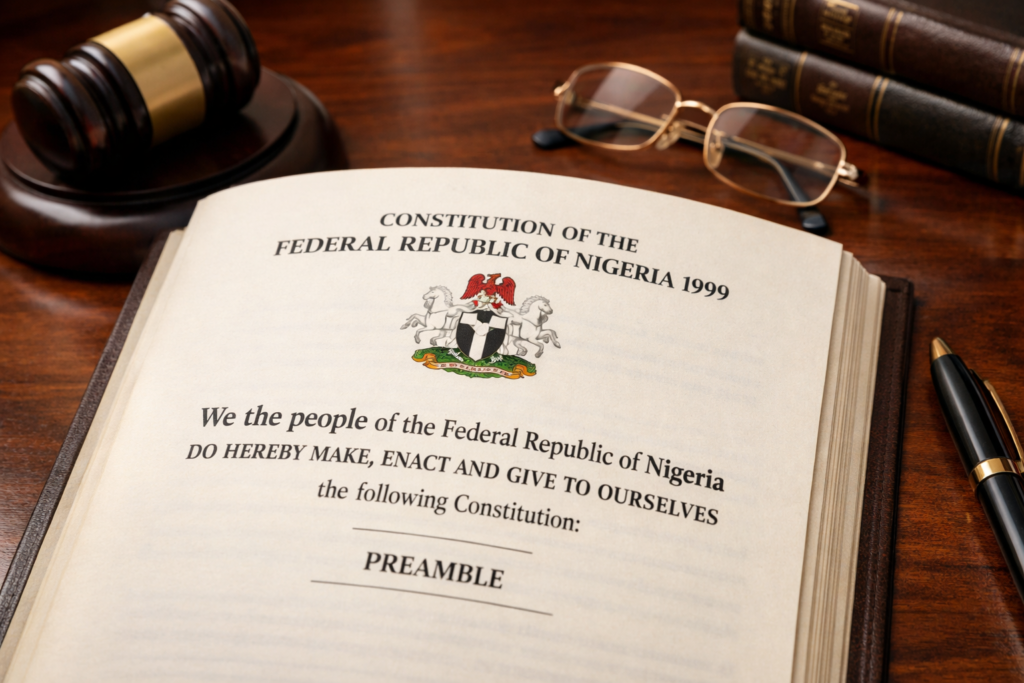
The Constitution of the Federal Republic of Nigeria begins with a striking declaration:
“We the people of the Federal Republic of Nigeria… do hereby make, enact, and give to ourselves the following Constitution.”
These opening words carry significant symbolic weight. They place the Nigerian Constitution within a long tradition of constitutional thought in which the authority of political order is said to originate not from monarchs, military rulers, or colonial administrators, but from the collective will of the people themselves.
Yet the statement also introduces what might be called a constitutional fiction.
In constitutional theory, such language is not unusual. Constitutions often speak in the voice of a unified people acting together to establish the rules of their common political life. The phrase “We the people” represents the principle of popular sovereignty—the idea that legitimate authority ultimately flows from the citizens who compose the political community.
The difficulty in Nigeria’s case is historical. The Nigerian people did not visibly assemble in a constitutional moment to draft, deliberate upon, and adopt the document that now governs them.
The present Constitution entered public life in 1999 through a decree issued during the transition from military rule under Abdulsalami Abubakar. While the transition marked an important return to civilian government, the constitutional text itself did not emerge from a broad civic convention in which citizens collectively articulated the framework of their political union.
This historical circumstance does not negate the Constitution’s legal authority. Nigerian institutions operate under it, courts interpret its provisions, and the state derives its formal structure from its clauses. In legal terms, the Constitution remains the supreme law of the land.
Yet the question raised by its opening words persists.
To what extent do Nigerians experience the Constitution as their own creation?
The Distance Between Text and Civic Life
A constitution can exist as a functioning legal instrument while remaining psychologically distant from the citizens whose lives it structures.
In societies where constitutional ownership is deeply rooted, the document becomes more than a legal framework. It enters the civic imagination. Citizens understand its language, invoke its principles, and see it as a structure that both empowers and restrains public authority.
Nigeria’s experience has often been different.
For many citizens, the Constitution is encountered primarily during political crises, election disputes, or judicial pronouncements. Outside these moments, it rarely appears as a living reference point in everyday civic life.
The result is a subtle but important gap. The Constitution governs the political order, yet the sense that it belongs to the people remains incomplete.
This gap becomes visible in moments of national tension. Citizens invoke constitutional rights in the language of protest, public officials appeal to constitutional authority in the exercise of power, and courts interpret constitutional provisions in resolving disputes. Yet the broader civic culture that sustains constitutional life—public familiarity with the document and a shared sense of its ownership—remains uneven.
The Question of Constitutional Ownership
The issue, therefore, is not simply the historical origin of the Constitution. Many constitutional orders evolve from imperfect beginnings. What ultimately sustains a constitution is not merely the circumstances of its birth but the degree to which a people gradually come to recognize themselves within it.
Ownership of a constitution emerges through civic practice.
Citizens begin to see the document as the architecture of their collective life. Its principles inform political expectations. Its language shapes public debate. Over time, the constitution becomes a shared reference point through which a society interprets both authority and responsibility.
Where this process takes root, the constitutional fiction of “We the people” begins to acquire real meaning.
A Reflection from Chambers
The Nigerian Constitution speaks in the voice of a united people.
Whether that voice fully reflects the lived civic consciousness of the nation remains an open question.
For in the end, the strength of a constitution lies not only in the authority of its provisions, but in the degree to which a people come to recognize themselves in its promise.
And it is through that gradual recognition that the words “We the people” move from constitutional fiction toward constitutional reality.
-
CONSTITUTIONALISM
The Discipline Behind the Document
Before we open the Constitution, we must ask a quieter question:
What is it that we are about to touch?
A constitution is a text.
Constitutionalism is a temperament.A constitution can be written in ink.
Constitutionalism must be written into the habits of power.Nigeria has a Constitution.
The more searching question is whether Nigeria has constitutionalism.This distinction is not semantic. It is civilizational.
I. The Birth of a Dangerous Idea
Constitutionalism emerged from a suspicion — a moral suspicion of power.
For most of human history, rulers governed because they could. Kings ruled by conquest. Emperors ruled by divine sanction. Military strongmen ruled by force. Authority flowed downward, unquestioned.
Constitutionalism introduced a radical inversion:
Power must justify itself.
Not only justify itself — but submit itself.
This was revolutionary.
It meant:
- The ruler is not above the law.
- Authority is delegated, not inherent.
- Power must operate within limits.
The law ceased to be merely an instrument of power.
It became the restraint of power.This is the essence of constitutionalism.
II. A Constitution Without Constitutionalism
It is possible to have a constitution and lack constitutionalism.
Military regimes often promulgate constitutions.
Autocracies often display elaborate constitutional texts.
Even dictatorships speak the language of rights.The presence of a document does not guarantee the discipline of limitation.
Constitutionalism requires more than a text. It requires:
- Supremacy of Law – No office-holder stands above the Constitution.
- Separation of Powers – Authority is distributed to prevent concentration.
- Judicial Review – Courts can invalidate unlawful acts.
- Protection of Rights – Citizens possess enforceable liberties.
- Accountability Mechanisms – Power answers to process.
Without these, a constitution becomes ceremonial — a national brochure.
With them, it becomes a living restraint.
III. The Psychological Core of Constitutionalism
Constitutionalism is not merely institutional. It is psychological.
It assumes that human beings, left unchecked, will expand their power.
This is not cynicism; it is anthropology.
From ancient Rome to modern republics, history confirms a pattern:
- Power centralizes.
- Privilege accumulates.
- Oversight weakens.
Constitutionalism is the architecture built against that gravity.
It is distrust, made constructive.
It does not assume leaders are evil.
It assumes leaders are human.And therefore, structures must exist.
IV. Sovereignty Reimagined
Before constitutionalism, sovereignty was personal.
The monarch embodied the state.
With constitutionalism, sovereignty becomes impersonal.
The authority of the state derives not from a throne, but from a constitutional order. The ultimate source of legitimacy shifts from ruler to norm.
This is why preambles often begin with “We the People.”
It is a theological shift in political language.
Authority is no longer mystical.
It is mediated.But here lies the tension — and Nigeria must confront it.
When a constitution says “We the People,” yet emerges without a referendum, what is being asserted? What is being assumed?
Is popular sovereignty proclaimed?
Or performed?That question will become sharper when we approach the Nigerian preamble.
V. Constitutionalism and the Fear of Majorities
One paradox of constitutionalism is that it limits not only rulers, but also majorities.
Democracy allows majorities to decide.
Constitutionalism prevents majorities from destroying fundamentals.
This is why constitutions protect rights even when popular sentiment shifts. This is why courts sometimes invalidate laws passed by elected assemblies.
It is not anti-democratic.
It is democracy restrained by principle.Constitutionalism insists that certain things are not subject to mood.
VI. Constitutionalism vs Mere Legality
A regime can act legally and still be unconstitutional in spirit.
Legality asks:
- Was the proper procedure followed?
Constitutionalism asks:
- Does this align with the deeper structure and purpose of limited government?
A government may pass laws that technically comply with procedure but undermine liberty, federal balance, or accountability.
Constitutionalism is therefore thicker than legality.
It is the moral ecology within which legality operates.
VII. Nigeria and the Question of Formation
Nigeria’s constitutional journey has been turbulent:
- Colonial instruments
- Post-independence constitutions
- Military suspensions
- Transitions
- The 1999 promulgation
The current Constitution was enacted during a military-to-civilian transition. It was not subjected to popular referendum.
This historical fact does not invalidate it. But it complicates its narrative.
Which raises a profound question:
Does Nigeria struggle because of constitutional defects?
Or because constitutional culture has not matured alongside the text?Constitutionalism cannot be downloaded.
It must be internalized.Institutions alone cannot sustain it.
Civic expectation must demand it.VIII. Constitutionalism as Civic Education
Constitutionalism thrives where citizens understand:
- The limits of executive power.
- The role of the judiciary.
- The structure of federalism.
- The nature of rights.
Where citizens do not understand the Constitution, political actors operate without meaningful constraint.
Ignorance is fertile soil for constitutional erosion.
Therefore, constitutional commentary is not academic indulgence. It is civic formation.
A nation that does not read its Constitution cannot defend it.
IX. The Discipline of Restraint
At its deepest level, constitutionalism is about restraint.
Not only restraint of rulers.
But restraint of impulse.
It is the discipline of process over passion.
Procedure over personality.
Structure over spontaneity.It insists that:
- Emergency does not erase limitation.
- Popularity does not confer immunity.
- Office does not equal ownership.
This discipline is difficult in young democracies.
It feels slow. It feels obstructive. It feels bureaucratic.But that friction is the price of freedom.
X. Before We Open the Nigerian Constitution
We must decide what we expect from it.
If we expect miracles, we will be disappointed.
If we expect it to structure power, we may begin to understand it.
The Constitution is not a savior.
It is a scaffold.Constitutionalism is the willingness to build within that scaffold — even when inconvenient.
As we proceed to examine the Nigerian Constitution, beginning with its preamble, we do so not merely to interpret clauses, but to interrogate ourselves:
- Do we desire limited government?
- Do we respect institutional boundaries?
- Do we understand federal balance?
- Do we believe law binds power?
If constitutionalism is absent, constitutional text becomes ornamental.
If constitutionalism matures, the document becomes transformative.
Closing Reflection
Constitutionalism is the discipline behind the document.
It is the quiet architecture that stands between authority and abuse.
Before we open the 1999 Constitution of the Federal Republic of Nigeria, we must first understand this discipline.
Only then can the preamble speak with weight.
In the next essay, we turn to a question that seems simple but is anything but:
What is a Preamble — and what does it mean to say “We the People”?